Canine Cache of Tools
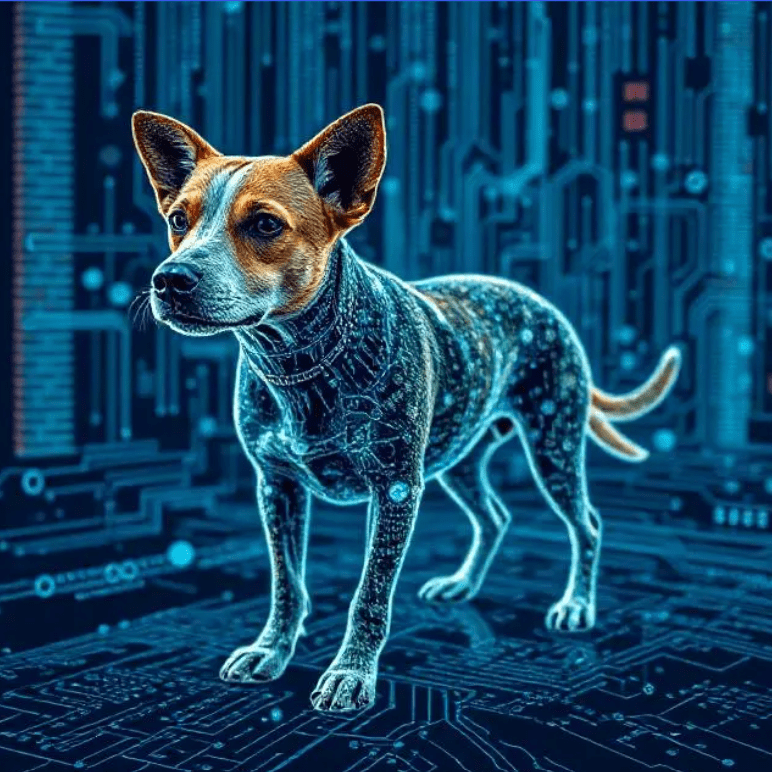
So, if we’re thinking of all these tools and libraries in a dog life context, they help machines “learn” in the same way you learn new tricks, solve problems, or understand your environment. And just like you might prefer one ball over another, different tools work better for different tasks. It’s all about finding the right fit for the job!
Python – Your Human’s Favorite Tool
First, let’s talk about Python. This is like your human’s favorite chew toy. It’s versatile and easy to handle, kind of like a squeaky ball that anyone can play with, whether you’re a pup or a pro! Python is often used in machine learning (ML) because it’s simple and has a ton of tools made for machine learning.
Key Libraries in Python (think of them as special treats):
- NumPy – Like a treat jar, it helps you with numbers and math, and is perfect for when you need to fetch some data for analysis.
- Pandas – It’s like a food bowl where all the data is served in neat rows, so you can easily chow down and figure out what you’re working with.
- Matplotlib/Seaborn – These are like your “sight” in the world of data. If you’re exploring a new area and want to see how things shift over time or across categories, these tools help you draw graphs and charts that show you the big picture.
Scikit-Learn – Your Training Leash
Scikit-learn is like the leash that helps you train. It’s where you can find all the basic ML models (like decision trees, random forests, and k-nearest neighbors), and it lets you practice how to solve problems, like fetching the right stick or sitting on command. It’s easy to use, like a simple game of fetch!
TensorFlow – Your Advanced Training Collars
TensorFlow is a bit more advanced. Think of it as the special collar that gives you access to new, more complex training exercises. It’s a powerful tool for deep learning and helps with tasks like recognizing patterns, understanding images, or making predictions (like, “Will I get my treat after I sit?”). With TensorFlow, you can build neural networks, which are like the brains of your machine learning system.
Keras – The Treat-Dispenser for Neural Networks
Keras is a high-level library that works with TensorFlow. If TensorFlow is like the collar, then Keras is like the treat dispenser that makes training those neural networks easier. Instead of setting up everything from scratch, Keras lets you give the network a few simple commands to get it going, much like teaching a dog a few key commands.
PyTorch – The Flexible Leash
PyTorch is another popular tool for training models. It’s kind of like a leash that gives you more flexibility. It’s often favored by researchers because it allows you to experiment quickly and easily (kind of like running free in a dog park!). It’s also good for deep learning tasks and is known for being fast and efficient.
OpenCV – Sniffing Around for Images
If you want to teach a dog to recognize objects, OpenCV is the tool. OpenCV is used for computer vision, and it helps machines “see” the world just like a dog sniffs out its favorite spot. It’s great for things like recognizing faces, objects, or tracking movement.
Natural Language Toolkit (NLTK) – The Language of Barks
This one is like teaching a dog to understand and interpret barks. NLTK is a library for working with human language, processing text, and analyzing patterns in speech or writing. If your dog were trying to decode what humans are saying, NLTK would help break down the sounds and words.
XGBoost/LightGBM – The Fast Fetchers
Both XGBoost and LightGBM are incredibly fast and efficient libraries for boosting machine learning models. If you were a dog, they’d be the kind of breeds that run super fast to fetch the ball before anyone else. They work by tweaking and improving decision trees to make predictions even more accurate.
 Yun.Bun
Leave a comment