Wilderness Detection
In the previous post, we explored alpine mountainous dogs—remember the old pack: Bernese Mountain Dog, Great Pyrenees, and Tibetan Mastiff. Now, let’s shift focus to the rugged landscapes they call home—dense coniferous forests, rocky outcrops, and steep trails lined with towering pines, firs, and spruces.
<!DOCTYPE html>
<html lang="en">
<head>
  <meta charset="UTF-8">
  <title>Kernel Function Visualizer</title>
  <style>
    body {
      font-family: Arial, sans-serif;
      text-align: center;
      padding: 20px;
    } #Want access? Check out Yun.Bun I/O
Firstly, to set the scene, let’s dive into some maths. What exactly is RKHS? It stands for Reproducing Kernel Hilbert Space, a Hilbert space of functions where the evaluation at any point can be expressed as an inner product with special functions known as kernels.
Equation: f(x)=⟨f,K(x,⋅)⟩
A RKHS is a special type of Hilbert space where functions live. Hilbert spaces provide a rigorous framework for defining notions like distances, inner products, and orthogonality in infinite-dimensional settings.
Introducing Kernels! In an RKHS, every function can be evaluated at any point using an inner product with a special function called a kernel. The kernel function determines the geometry and smoothness properties of the space. Common examples include the Gaussian kernel and polynomial kernel.
Equation: K(x,⋅)
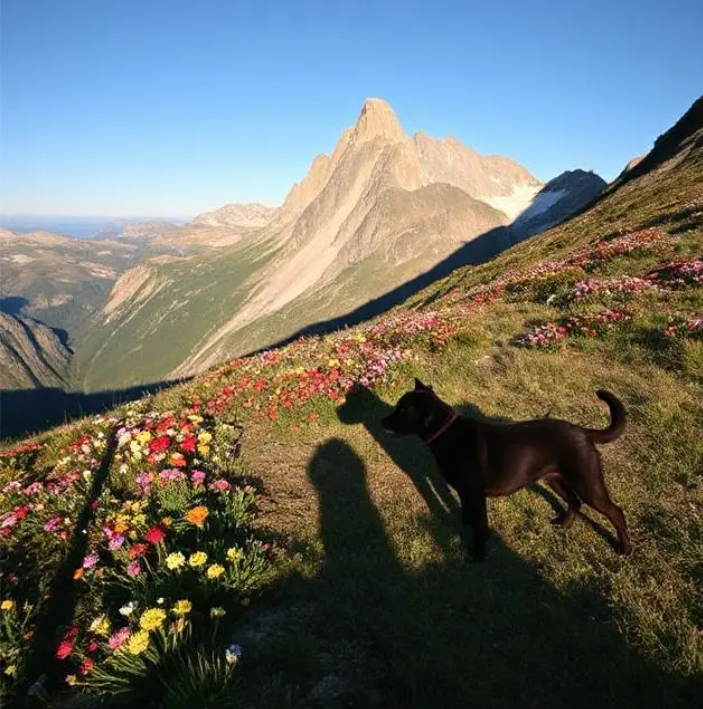
Here’s a photo I took a few days ago during a recent fantastic excursion near Chamonix, Switzerland. Kernel methods can be used to analyze patterns in flower and leaf images, with RKHS providing a mathematical framework for representation.

1st – Feature Extraction
Every image consists of thousands of pixels. Instead of working with raw pixel values, we extract meaningful features, such as: The shape and contour of petals and leaves, Texture patterns on surfaces, Color histograms showing the distribution of colors and Vein structures in leaves.
2nd – Applying Kernels to Measure Similarity
Kernel functions map these features into a higher-dimensional space, enabling more effective similarity comparisons: Gaussian (RBF) Kernel identifies how alike two flower images are despite lighting or perspective changes. Polynomial Kernel models relationships between petal shapes and leaf structures. Histogram Intersection Kernel is ideal for color-based classification.
3rd – Classification Using RKHS
After mapping features with kernels, Reproducing Kernel Hilbert Space (RKHS) provides a strong foundation for classification: To categorize different flower species, an SVM (Support Vector Machine) classifier leverages RKHS to separate classes efficiently. To group similar leaves, a clustering method like Kernel k-means works effectively.
4th – Image Segmentation with Kernels
When isolating specific parts of an image (e.g., separating flowers from the background), kernel-based segmentation techniques can be useful: Graph-based Kernels help segment different areas for refined analysis. Kernel PCA (Principal Component Analysis) reduces noise and highlights key features.
Feeling adventurous? Try experimenting with Python – packed with OpenCV, Scikit-learn, and NumPy – or explore MATLAB for advanced image processing and kernel methods. Want to see some flowers instead? Check out ‘The Scripts‘.
*Noted* Red boxes mark matching regions, capturing large blooms. Lighting and background variations accounted too.
2 responses to “9”
-
It’s so amazing to me that math can be used to recreate the natural beauty of the world. It’s fascinating.
LikeLike
-
I loved the mix of nature and problem-solving — it really made me think about how much we can notice (or miss) out in the wild. And the mountain dogs? That part made me smile big. Feels like there’s a whole world out there working quietly behind the scenes.
LikeLike


 Yun.Bun
Leave a reply to Sonia S. Cancel reply